Distribute 4K audio and video over a standard Ethernet network instead of dedicated point-to-point matrix cabling. ADHOOPU AV over IP endpoints scale to hundreds of screens — video walls, campuses, control rooms and KVM applications — without re-cabling. One system covers encode, decode, matrix switching and KVM, so the project ends up as a single IP video distribution system with one management interface instead of two parallel cabling plants.
AV OVER IP · AUDIO VIDEO OVER IP · NETWORKED AV · IP VIDEO DISTRIBUTION · DISTRIBUTED AV SYSTEM · AV OVER ETHERNET · IP VIDEO MATRIX · SCALABLE AV DISTRIBUTION · AV OVER IP SYSTEM · IP VIDEO DISTRIBUTION SYSTEM · VIDEO WALL OVER IP · ADHOOPU AV OVER IP
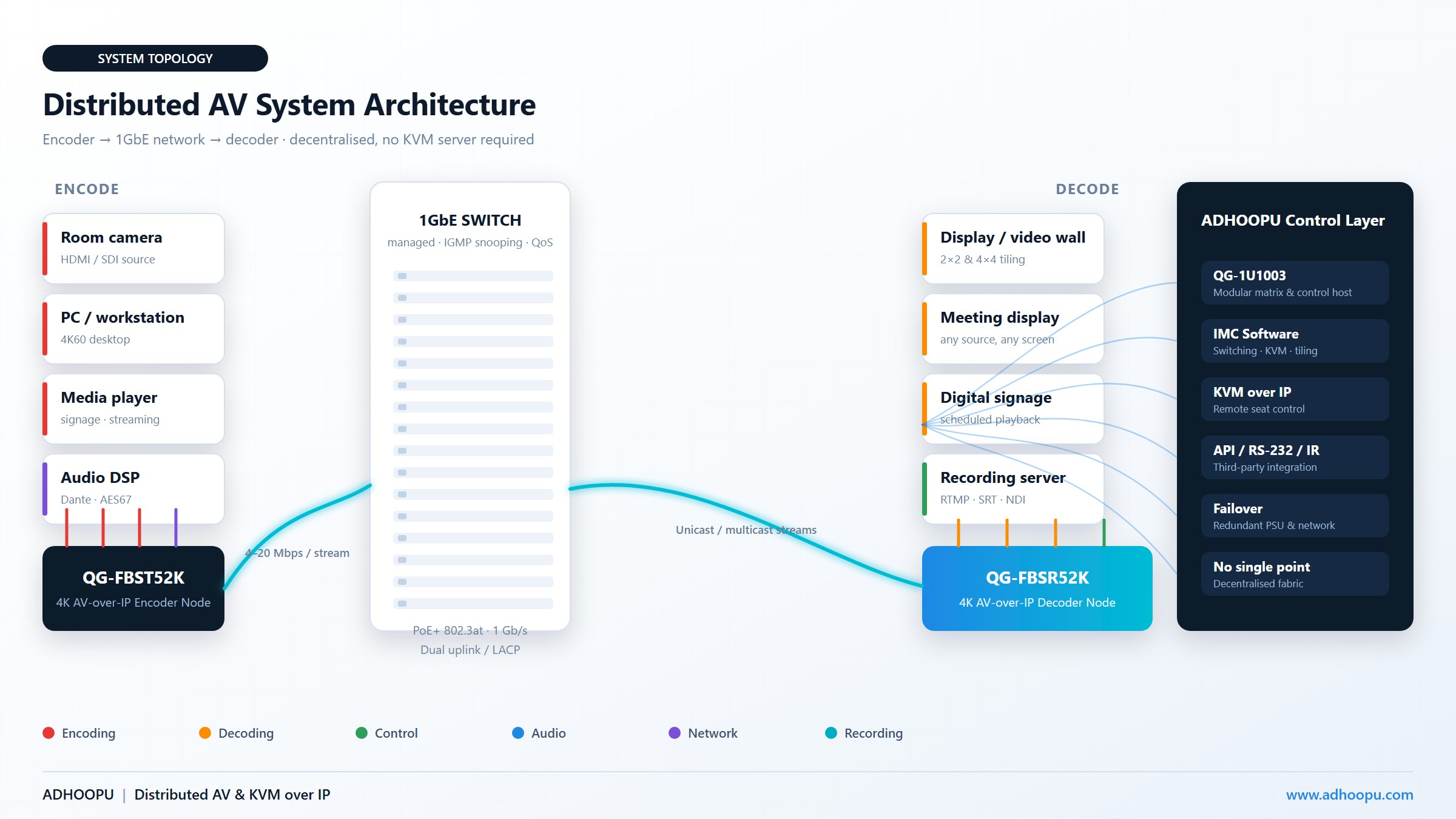
A traditional AV matrix requires a dedicated cable from every source to the matrix and from the matrix to every display. Adding one screen means new cabling. AV over IP changes the architecture: each source becomes an encoder on the network, each display becomes a decoder, and routing happens in software. Scaling from 8 screens to 200 screens means adding endpoints, not rebuilding the cabling infrastructure.
Scalable AV distribution across existing network infrastructure. Add endpoints as the project grows — campuses, multi-building sites and phased rollouts become practical.
Any source any screen routing with point-to-point, point-to-multipoint and many-to-many AV distribution, plus multi-screen video distribution and video wall layouts.
Long distance AV over IP over standard fibre or copper network links, with low latency AV over IP suitable for live operations and control rooms.
KVM over IP and distributed KVM let operators control remote machines from a control room — control room KVM and command center KVM deployments.
Video wall controller over IP for operations centres, traffic management and security operations rooms with flexible window layouts.
Centralised AV management of every endpoint: status, firmware, routing presets and scheduled actions from one interface.
Two core endpoints cover the majority of networked AV projects. Both are available under your own brand through the OEM/ODM programme.
4K AV over IP encoder converting HDMI and audio sources into low-latency network streams for distribution, recording and video wall display.
4K AV over IP decoder receiving network streams and driving displays, video walls and multi-screen layouts with flexible windowing.
Where networked AV replaces traditional matrix infrastructure.
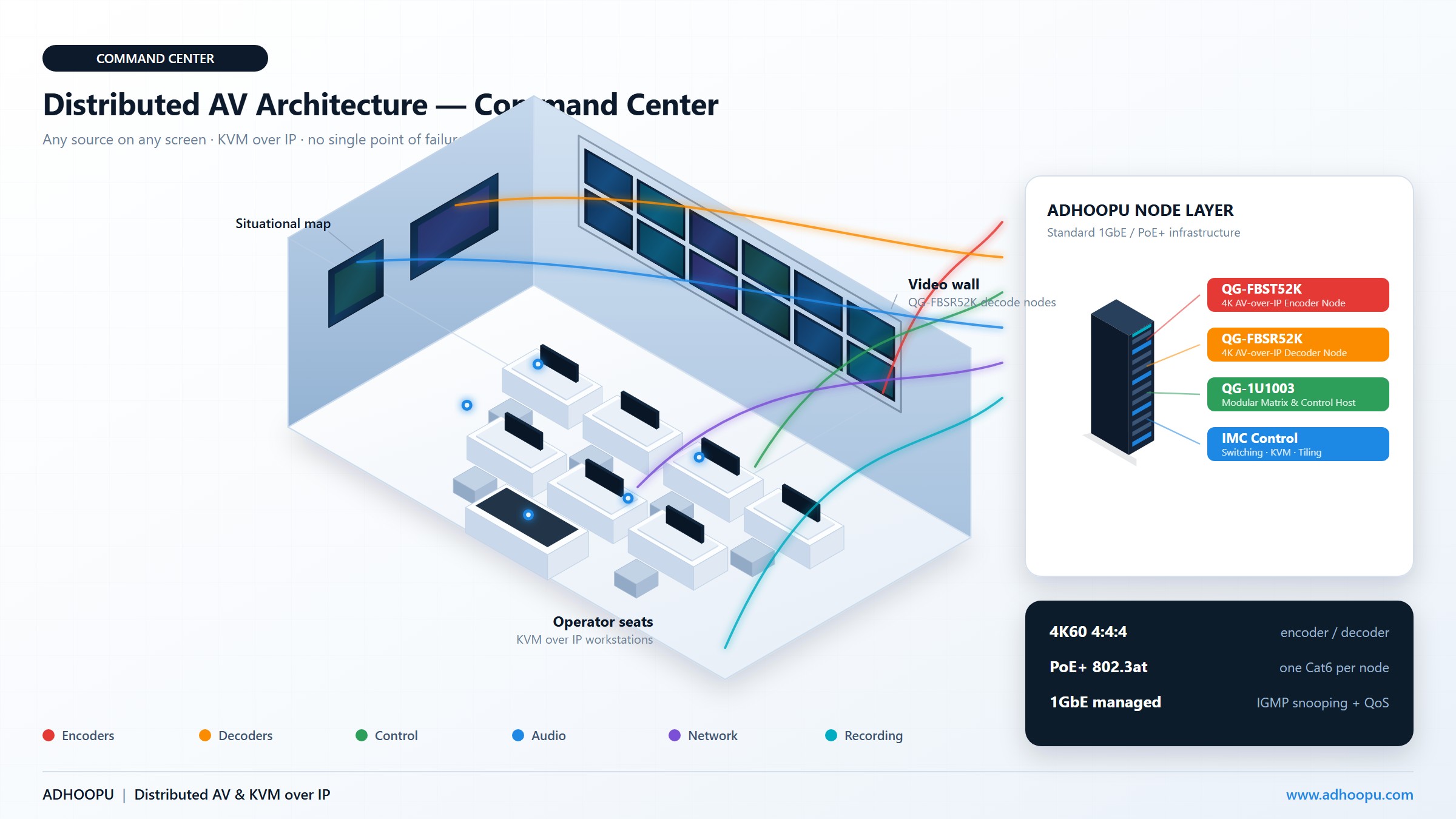
Command center AV over IP, mission critical AV, operations center AV distribution and emergency command center AV for government and enterprise operations rooms.
Security operations center AV, network operations center AV and traffic control center AV with video wall control and KVM.
Courtroom AV over IP and hospital AV over IP for distributed recording, evidence display and clinical teaching networks.
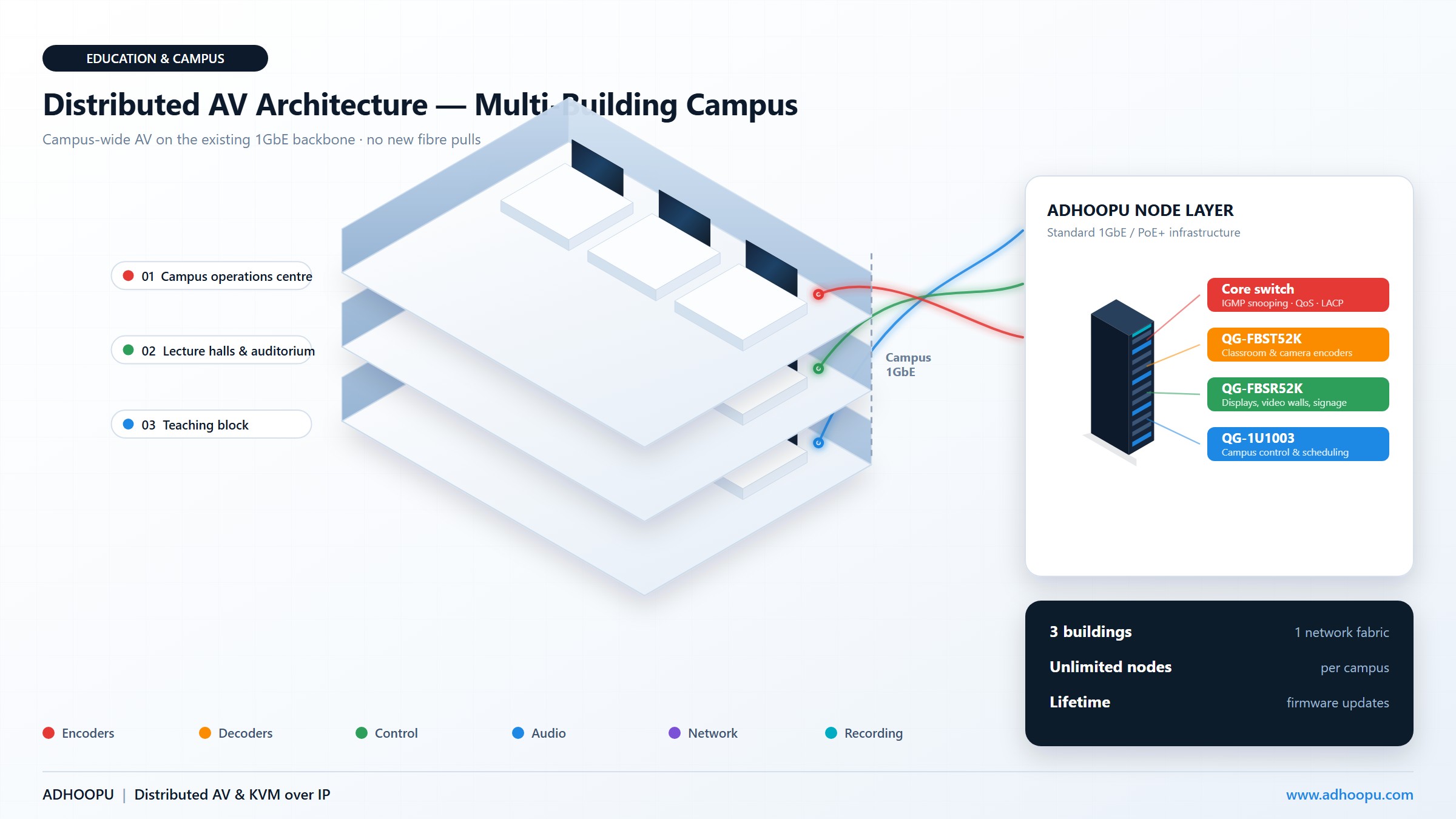
Campus AV over IP and education AV over IP distributing lectures across buildings, with central scheduling and control.
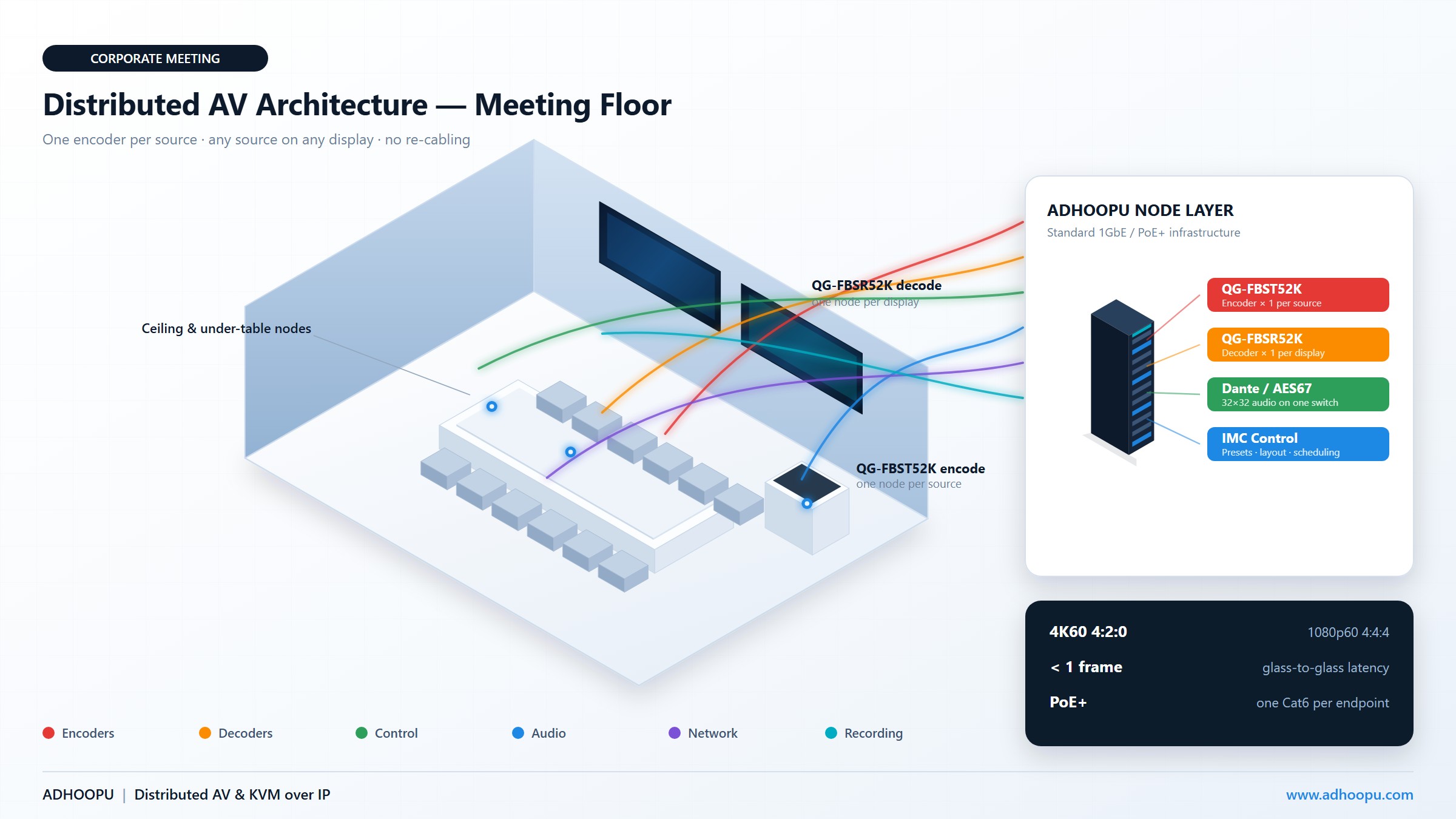
Enterprise AV distribution and government AV over IP for meeting rooms, briefing centres and multi-floor corporate sites.
Video wall control room deployments with flexible multi-window layouts across large display arrays.
Technical questions from integrators designing networked AV projects.
Tell us the number of sources, screens, buildings and whether KVM is required. We reply within 24 hours with a recommended endpoint count and configuration.
Model-level and family-level comparison pages for the AV-over-IP systems most often specified against ours. Each page covers the architecture difference, a side-by-side capability table and the migration questions integrators actually ask.
Compare all AV over IP alternativesVendor-neutral reference material written by our engineering team for integrators, consultants and end users. Free to read, free to quote in a specification or tender document.
The eight dimensions worth comparing, a network readiness checklist, sizing guidance from 2 to 500+ endpoints, and the eight pitfalls that cost integrators real money.
Read the guide ›Appliance-managed, integrated and software-only architectures compared across total cost of ownership, scaling model and support reach.
Open the matrix ›Every term that comes up in AV over IP meetings, quotations and commissioning documents, defined in plain language.
Open the glossary ›Three deep dives that answer the questions which come up after the platform is chosen: how endpoints pair, how a wall is controlled, and what a distributed system really requires.
One decoder per panel, layout presets on an on-premise platform, no proprietary chassis. Includes a sizing table from a 2×2 wall to 120+ panels.
Encoder and decoder specification table, bitrate per codec profile, streams per 1GbE port and a stage-by-stage latency budget.
What distribution changes in the design, the centralised-versus-distributed comparison, and the four questions that reveal who really owns the firmware.
Platform, endpoints and firmware ownership compared before you shortlist.
One decoder per panel, layout presets on-premise, no proprietary chassis.
Encoder/decoder pairing, bitrate per codec profile, latency budget per stage.
What distribution changes in the design, and who really owns the firmware.
Professional AV manufacturer — Integrated AV Platforms, Distributed AV over IP, and AI Edge Computing & Video Analytics. OEM/ODM for system integrators, distributors and AV brands worldwide.
19 years of AV engineering · Shenzhen, China · 3-year warranty
The ADHOOPU fabric delivers distributed AV-over-IP, video over IP and HDMI over IP on standard 1GbE networks: IP video distribution, audio over IP, low-latency AV over IP and multicast video distribution with IGMP snooping. Build a network video matrix from AV-over-IP encoders and AV-over-IP decoders, with USB over IP and KVM for operator workstations.
Evaluating a Crestron DM NVX alternative or an Extron NAV alternative? ST52K and SR52K nodes provide 4K AV over IP encoder/decoder functionality at a far more accessible cost point than an equivalent fixed matrix, scaling by adding nodes instead of replacing chassis.
A traditional matrix switcher is a fixed-size hardware chassis with a fixed number of inputs and outputs. AV over IP distributes video over a standard IP network, so any input can be routed to any output simply by adding encoder or decoder nodes — you scale the matrix by adding nodes, not by replacing hardware.
Yes. ST52K and SR52K run on standard managed 1GbE switches with IGMP snooping and QoS. For large node counts, 1GbE uplinks between access switches are recommended.